KCNA: Kubernetes Architecture & Fundamentals
- 8 minsKubernetes Architecture & Fundamentals
Kubernetes (K8s) is the industry-standard container orchestrator. It automates the operational needs of running containers, including provisioning, deployment, scaling, and networking. For the KCNA, you must understand not just what it does, but how the internal “gears” turn.
Orchestration
Kubernetes provides the framework to run distributed systems resiliently.
| Function | Description | Why It Matters |
|---|---|---|
| Provisioning & Deployment | Automated container lifecycle management | Faster, consistent deployments |
| Scaling | Automatic scaling based on demand | Cost efficiency and performance |
| Self-Healing | Automatically fix/replace failed containers | High availability |
| Scheduling | Efficient use of compute resources | Resource optimization |
| Service Exposure | Making container services accessible | Network connectivity |
| Security & Authorization | Access control and security policies | Protection and compliance |
| Storage Management | Shared/persistent workload storage | Data persistence |
| Extended Functionality | Custom Resource Definitions (CRDs) | Platform extensibility |
Self-Healing Capabilities
- Automatically detects failed containers
- Replaces unhealthy instances with new ones
- Maintains desired state without human intervention
- Ensures high availability of applications
Custom Resource Definitions (CRDs)
- Expand Kubernetes beyond core functionalities
- Allow creation of custom API objects
- Enable platform-specific extensions
- Support operator patterns for complex applications
The Hierarchy of Components
A Kubernetes environment is organized in a specific nesting doll structure: Cluster > Node > Pod > Container
- Cluster: A set of nodes grouped together. If one node fails, others take over.
- Node: A physical or virtual machine managed by the control plane.
- Pod: The smallest unit in K8s. One or more containers that share storage, network, and execution context.
- Container: The isolated application process.
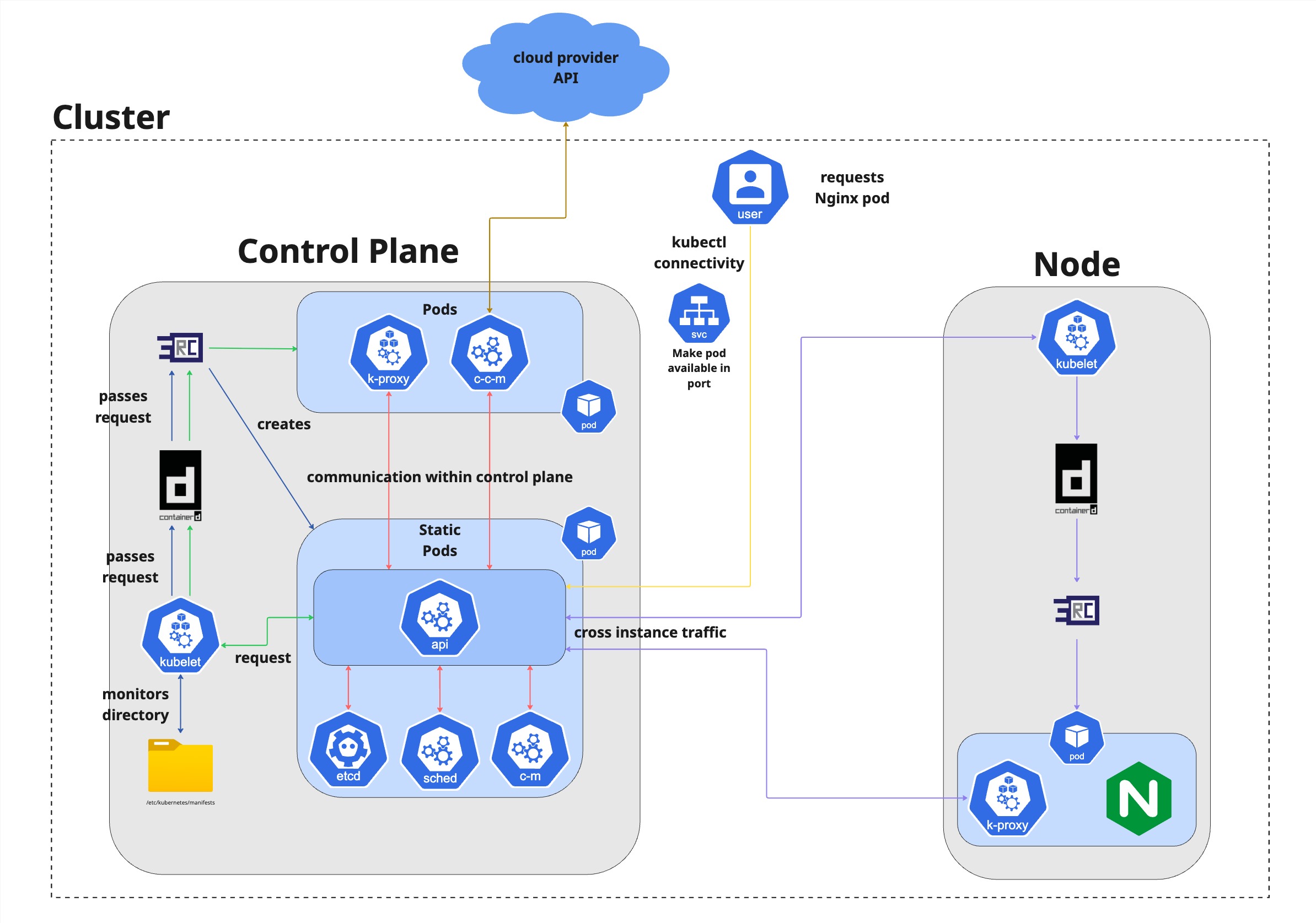
The Big Picture
🏢 Kubernetes Cluster
│
├── 🧠 Control Plane
│   ├── 🌐 kube-apiserver (API Gateway)
│   ├── 📅 kube-scheduler (Pod Placement)
│   ├── 🎛️ kube-controller-manager (State Management)
│   ├── ☁️ cloud-controller-manager (Cloud Integration - Optional)
│   ├── 🗄️ etcd (Key-Value Store)
│   ├── 🏷️ CoreDNS (DNS Resolution)
│   └── 🤖 kubelet (Node Agent)
│
└── 💼 Worker Nodes
    ├── 🤖 kubelet (Node Agent)
    ├── 🌐 kube-proxy (Network Proxy - Optional)
    ├── 🏷️ CoreDNS (DNS Resolution)
    ├── 🔧 Container Runtime
    │   ├── 📦 containerd/CRI-O (High-level Runtime)
    │   └── 🏃 runc (Low-level Runtime)
    ├── 📦 Pods
    │   ├── 🏃 Application Containers
    │   └── 🔧 Sidecar Containers (Optional)
    └── 📁 Static Pods (in /etc/kubernetes/manifests)
        ├── 🗄️ etcd (Control Plane)
        ├── 🌐 kube-apiserver (Control Plane)
        ├── 🎛️ kube-controller-manager (Control Plane)
        └── 📅 kube-scheduler (Control Plane)
The Control Plane
The control plane manages the overall state of the cluster, coordinates activities, and ensures the “Desired State” matches the “Actual State.”
kube-apiserver
Role: The core component server that exposes the Kubernetes HTTP API
It is the “front door” for all internal and external requests.
Key Functions:
- Handles requests and authenticates them
- Authorizes incoming requests
- Routes requests to appropriate components
- Primary interface for all cluster interactions
In High Availability setups, nodes connect to the API server via a Load Balancer to distribute traffic across multiple replicas.
etcd
Role: Consistent and highly-available key-value store for all API server data
- Mechanism: Uses the RAFT Consensus Protocol to ensure all nodes agree on the state, even during failures.
- Best Practice: Use an odd number of instances (ideally 5) for production to handle leader elections and network partitions.
kube-scheduler
Role: Assigns Pods to suitable nodes based on constraints and resources:
Decision Factors:
- Node labels and selectors
- Taints and tolerations
- Affinity and anti-affinity rules
- Available resources (CPU, memory)
- Node capacity and utilization
Process:
- Looks for unbound Pods in etcd
- Evaluates valid nodes based on constraints
- Makes placement decision
- Updates etcd with the decision
kube-controller-manager (c-m)
Role: Runs controllers to implement Kubernetes API behavior
Runs control loops that monitor the cluster. For example, if a node goes down, the controller-manager notices and responds to maintain availability and desired state.
cloud-controller-manager (c-c-m)
Role: Integrates with underlying cloud providers
The c-c-m is an optional component that acts as an interface between K8s and cloud providers. It manages:
Responsibilities:
- Node management: Creating and deleting cloud instances
- Persistent volume management
- Load balancing: Creating and managing load balancers for services
- Cloud-specific networking integration
Deployment: Resides on the control plane alongside other control plane components
Control Plane Components:
├── 🌐 kube-apiserver
│   └── 🔐 Authentication & Authorization
├── 🗄️ etcd
│   ├── 📚 Cluster State Storage
│   ├── ⚖️ RAFT Consensus Protocol
│   └── 🗳️ Leader Election
├── 📅 kube-scheduler
│   ├── 🏷️ Node Selection Logic
│   ├── 💻 Resource Awareness
│   └── 🎯 Placement Decisions
├── 🎛️ kube-controller-manager
│   ├── 🔄 Control Loops
│   ├── 👀 State Monitoring
│   └── 🛠️ Remediation Actions
├── ☁️ cloud-controller-manager (Optional)
│   ├── 🖥️ Node Management
│   ├── ⚖️ Load Balancer Integration
│   └── 💾 Storage Integration
└── 🏷️ CoreDNS
    ├── 🔍 Service Discovery
    ├── 🌐 DNS Resolution
    └── 📡 Dynamic Updates
Node Components
Each worker node contains the services necessary to run application pods. Worker nodes are responsible for executing application pods and containers.
kubelet
Role: Ensures Pods are running, including their containers
Key Features:
- Maintains desired state of pods (from pod specs)
- Uses YAML/JSON pod specifications
- Receives requests via API or directory monitoring
- Monitors
/etc/kubernetes/manifestsfor static pods - Runs on every node (including control plane)
kubelet → Container Runtime (containerd) → Low-level Runtime (runc) → Containers
kube-proxy (Optional)
Role: Maintains network rules to implement Services
Functions:
- Runs on each node in the cluster
- Handles communication between pods and services
- Routes traffic and handles requests
- Implements service networking
Container Runtime
Role: Software responsible for running containers
Critical Importance:
- If it crashes, it can no longer manage containers
- All running pods stop abruptly when runtime fails
- Empowers Kubernetes to run containers effectively
Worker Node Components:
├── 🤖 kubelet
│   ├── 📦 Pod Lifecycle Management
│   ├── 🔄 Container Runtime Interface (CRI)
│   ├── 📁 Static Pod Monitoring (/etc/kubernetes/manifests)
│   └── 🌐 API Server Communication
├── 🌐 kube-proxy (Optional)
│   ├── 🔀 Traffic Routing
│   ├── ⚖️ Load Balancing
│   └── 🌉 Service Implementation
├── 🔧 Container Runtime Stack
│   ├── 📦 High-level Runtime
│   │   ├── containerd (CNCF Graduated)
│   │   ├── CRI-O (Kubernetes-native)
│   │   └── Docker (Legacy support)
│   └── 🏃 Low-level Runtime
│       ├── runc (OCI Reference)
│       └── crun (Alternative)
├── 🏷️ CoreDNS (Pod-based)
│   ├── 🔍 Cluster DNS
│   └── 📡 Service Resolution
└── 📦 Pod Workloads
    ├── 🏃 Application Containers
    ├── 🔧 Init Containers
    ├── 🛡️ Sidecar Containers
    └── 📁 Static Pods
Container Runtimes: High Level vs. Low Level
Kubernetes uses the CRI (Container Runtime Interface) to interact with runtimes. This architecture is layered:
- High-Level Runtime (e.g., Containerd): Manages the entire lifecycle. It pulls images, stores them, and manages network/storage.
containerdwas donated to the CNCF and is a “Graduated” project. - Low-Level Runtime (e.g., runc): The reference implementation of the OCI spec. It interacts directly with Linux Namespaces and cgroups to spawn the container.
containerd
- Created by and used within Docker
- Donated to CNCF (Graduated project)
- Manages entire container lifecycle
- Pulls and stores container images
- Interacts with low-level runtimes like runc
- Installation:
apt/yum install containerdautomatically includes runc
runc - The Foundation
- Reference implementation of OCI runtime spec
- Donated by Docker Inc
- OCI-compatible container runtime
- Interacts with Linux components (namespaces, cgroups)
- Low-level container execution
Container Runtime Interface (CRI)
- Standardized interface between kubelet and container runtimes
- Enables kubelet to use various container runtimes
- Promotes interoperability and choice
- Abstracts runtime details from Kubernetes
Networking & Service Discovery
- CNI (Container Network Interface): A plugin that enables pod-to-pod communication across different nodes, ensuring every pod gets its own unique IP address.
- CoreDNS: Enhances service discovery by dynamically resolving DNS queries for cluster-internal Services and Pods.
Container Network Interface (CNI)
- Enables pod-to-pod communication across different nodes
- Each pod gets an IP address
- Standardized networking interface
- Plugin-based architecture
CoreDNS
Role: Enhances service discovery between applications
Functions:
- Dynamically resolves DNS queries
- Cluster-internal Services and Pods
- Automatic service registration
- Real-time DNS updates
Load Balancer Integration
In highly available configurations:
- Nodes connect to API server via load balancer
- Distributes traffic across multiple API server replicas
- Nodes don’t need specific IP addresses of API server instances
- High availability and fault tolerance
Pod Worloads
The smallest and simplest unit in the Kubernetes object model
Key Characteristics:
- Represents one or more containers that share resources
- Shared storage and networking
- Scheduled together as a single entity
- Co-located and co-managed containers
Immutability Principle
Containers are intended to be stateless and immutable
Never change the code of a container that is already running
- Rebuild and redeploy instead of modifying
- Version control through image tags
- Consistent behavior across environments
Communication Flow (kubectl)
👤 User Request
    ↓
🌐 kube-apiserver (Authentication/Authorization)
    ↓
🗄️ etcd (Store Desired State)
    ↓
📅 kube-scheduler (Pod Assignment)
    ↓
🎛️ kube-controller-manager (State Management)
    ↓
🤖 kubelet (Node Agent)
    ↓
📦 containerd (High-level Runtime)
    ↓
🏃 runc (Low-level Runtime)
    ↓
🐧 Linux Kernel (Namespaces/cgroups)
    ↓
🏃 Running Container

Lais Ziegler
Dev in training... 👋